

5 Service Delivery Systems to Scale Your Business Without Becoming the Bottleneck


“Your Revenue Grew. Did Your Systems?” five service delivery systems for scaling without becoming the bottleneck.
What 15 years inside Deloitte and Booz Allen taught me about delivering excellent client work without depending on founder heroics.
Winning the client was never the hard part.
The hard part comes after the contract is signed.
Suddenly, you're reviewing the work.
Your team is waiting for decisions.
The client still comes directly to you with questions.
You're checking deadlines, fixing problems, reviewing deliverables, and making sure nothing falls through the cracks.
And every new client adds more work to your calendar.
Revenue is growing.
But so is the business's dependence on you.
I spent nearly 15 years inside Deloitte and Booz Allen Hamilton, and one of the biggest lessons I took from those firms wasn't about working harder.
It was about the operating system behind the work.
Large firms don't deliver complex engagements by hoping talented people figure everything out.
There are service delivery systems behind the work, systems designed to create consistency, protect quality, and keep projects moving without depending on one person.
Clear roles.
Defined handoffs.
Repeatable methodologies.
Project governance.
Quality standards.
Your business may have five people instead of 50,000.
You don't need their infrastructure.
But you can absolutely borrow their discipline.
And if your goal is to build a business that can grow without requiring more of you at every stage, these five service delivery systems are a good place to start.
First, Understand "The Operational Bill"
I worked with a firm that had done what almost every founder wants to do:
They quadrupled their revenue.
From the outside, that looked like success.
Inside the business, something very different was happening.
The delivery model hadn't evolved with the revenue.
More clients meant more projects.
More projects meant more decisions.
More decisions meant more communication, more approvals, more coordination, and more opportunities for something to fall through the cracks.
The founder was still sitting in the middle of it all.
They had scaled revenue before they scaled operations.
So instead of four times the freedom, they had four times the operational complexity.
That's the operational bill founders don't see coming.
Growth eventually exposes every process you didn't build.
The question isn't simply:
How do we win more clients?
It's:
Can our current operating system handle the clients we're trying to win?
That's where these five systems come in.
System #1:
Standardized Client Onboarding (Start Before the Start)
The project begins before the client kickoff.
A lot of growing service firms treat the kickoff call as the beginning of the project.
By then, you're already behind.
Inside larger consulting firms, the team has clarity before the client ever joins that first call.
They know what was sold.
They know the expected outcome.
They know who owns the engagement.
They know the timeline.
They know what happens first.
The client shouldn't arrive at kickoff and watch your team figure out how the engagement is going to work.
That work should already be happening.
Before your next kickoff, your team should be able to answer four questions:
What exactly did we sell?
Who owns it?
What happens first?
What should the first 30 days accomplish?
This is why I recommend creating a Ready-to-Kickoff checklist.
Once the deal closes, there should be an internal handoff.
The scope gets reviewed.
Responsibilities are assigned.
The project plan is created.
Important client information is transferred.
Potential risks are identified.
Then you meet with the client.
The difference may seem small.
The client experience is not.
They walk into an organized engagement instead of watching you organize it around them.
Try this:
Before your next kickoff, give your team those four questions without answering them yourself.
Can they clearly explain what was sold, who owns it, what happens first, and what success looks like in the first 30 days?
If they can't, you're not ready to kickoff.
System #2:
Role Separation & Handoffs (Separate the Hats)
Talented people still need clear roles.
I worked with a PR firm where one person was effectively carrying seven different roles.
She was managing the client relationship.
Coordinating the project.
Tracking deadlines.
Reviewing deliverables.
Managing communication.
Solving problems.
And keeping the founder informed.
From the outside, she looked like an incredible operator.
And she was.
But the business had created a dangerous dependency around her.
If she became overwhelmed, the engagement felt it.
If she was unavailable, information stopped moving.
If something was missed, there wasn't another layer designed to catch it.
She wasn't just an important team member.
She had become a single point of failure.
Inside larger firms, responsibilities like these are intentionally separated.
You might have:
An engagement leader
A project manager
A subject-matter expert
A quality reviewer
A client relationship owner
An analyst
Operations support
Now, your five-person firm does not need to hire seven people.
But you do need to identify the seven roles.
One person may wear three hats today.
That's fine.
The important thing is that everyone understands which hat they're wearing, what decisions belong to that role, and when responsibility moves to someone else.
One person can hold multiple roles. But every role needs an owner.
Otherwise, you eventually create what I call:
A bottleneck with a job title.
Try this:
Take one active client engagement and write down every role required to deliver it successfully.
Don't write employee names yet.
Write the roles.
Then assign an owner to each one.
You'll quickly see where responsibilities are clear, where they overlap, and where one person is quietly carrying too much of the business.
System #3:
Process Standardization (Standardize the Process, Not the Thinking)
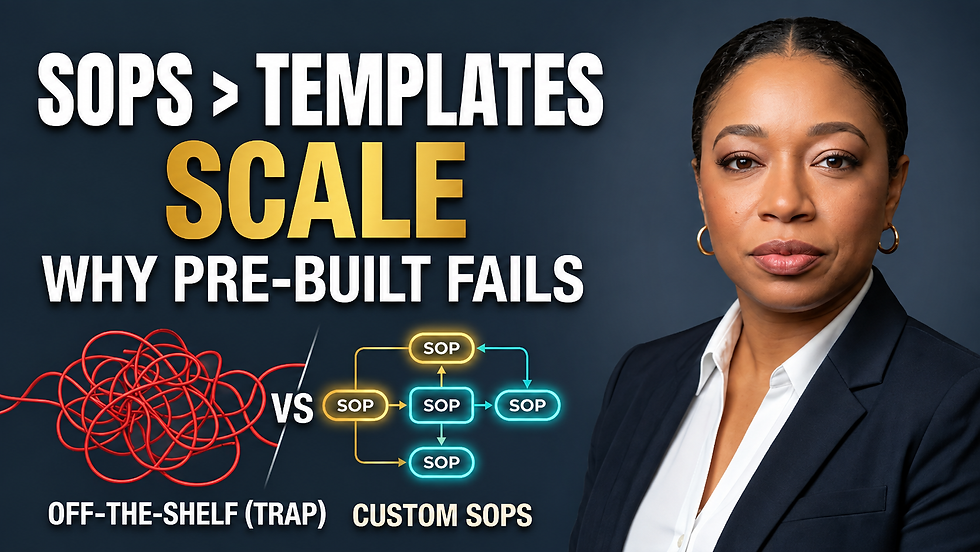
The answer is custom. The process is not.
One of the biggest objections I hear to standardization is:
“But every client is different.”
Of course they are.
Your clients hire you because they need your expertise applied to their specific situation.
But custom expertise doesn't require a custom operating process every single time.
Large consulting firms understand this.
They use methodologies.
Templates.
Frameworks.
Checklists.
Standard project plans.
Review processes.
They aren't reinventing the entire delivery model every time a new contract is signed.
And that doesn't make the work less strategic.
It gives the team more capacity for the work that actually requires strategic thinking.
Think about your own business.
Do you really need to create a brand-new kickoff agenda for every client?
A completely new project plan?
A new status report?
A different process for collecting client information?
A new quality review process?
Probably not.
Standardize the repeatable 80%.
Your onboarding.
Your project plans.
Your meeting agendas.
Your client communication rhythms.
Your status reporting.
Your internal handoffs.
Your quality checks.
Then customize the 20% where your expertise actually matters.
The answer is custom. The process is not.
This is how you scale expertise without turning your team into a factory.
Try this:
Choose one service you deliver repeatedly.
Ask:
What are we recreating every time that doesn't actually need to be recreated?
Turn those pieces into templates, checklists, frameworks, or standard operating procedures.
Your team should spend its best thinking on solving the client's problem, not rebuilding the machinery required to deliver the solution.
System #4:
Project Governance (Replace Check-ins With Governance)
Stop managing by asking, “How's it going?”
“How's it going?”
“Good.”
That's not project management.
But it's how many growing firms operate.
The founder sends a Slack message.
Someone gives a quick update.
You remember to ask about another project tomorrow.
Then something gets missed and suddenly everyone is trying to reconstruct what happened.
This works when the business is small enough for you to hold most of the moving pieces in your head.
It doesn't work forever.
I once worked on an initiative that involved approximately 1,200 locations.
You cannot manage something at that scale by walking around asking everyone how things are going.
You need governance.
You need a predictable way of knowing:
What milestone are we working toward?
Who owns it?
Are we on track?
What is at risk?
What decision needs to be made?
Who has the authority to make it?
What happens next?
Your business may not have 1,200 locations.
You don't need the same infrastructure.
But you need the same principle.
As complexity increases, informal communication becomes less reliable.
Governance doesn't have to mean more meetings.
Good governance should actually reduce unnecessary communication because everyone knows where information lives, when updates happen, what needs escalation, and who can make which decisions.
Instead of constantly asking your team for updates, you build a system that makes progress visible.
Try this:
At your next project meeting, don't ask:
“How's everything going?”
Ask:
What is on track?
What is off track?
What is at risk?
What decision needs to be made?
Who owns the next action?
Notice how different the conversation becomes.
System #5:
Institutionalized Quality Control (Get Quality Out of Your Head)
Quality assurance is a process, not a personality.
Here's one of the easiest ways to identify founder dependency.
Look at what happens immediately before something goes to the client.
Does it always come to you?
The proposal comes to you.
The presentation comes to you.
The report comes to you.
The email comes to you.
The final deliverable comes to you.
And you've probably told yourself there's a good reason:
I need to make sure it's right.
I understand.
Your reputation matters.
Your clients expect quality.
You built the standards.
But there's a problem.
If every important deliverable requires your approval before it can move forward, you haven't created a quality assurance system.
You've made yourself quality control.
And there's a limit to how much work one quality-control department can approve.
Quality needs to become teachable and repeatable.
That might mean creating:
Quality standards
Review checklists
Examples of approved work
Peer-review processes
Approval thresholds
Escalation rules
Clear definitions of what “client ready” means
A junior team member shouldn't have to read your mind to produce excellent work.
Your standards should live somewhere other than your head.
Your team shouldn't need access to your brain to deliver excellent work.
Try this:
The next time you review a deliverable, don't just correct it.
Document why you're making each correction.
What are you consistently looking for?
What mistakes do you repeatedly catch?
What makes something “ready” in your eyes?
Those answers are the beginning of your quality assurance system.
Why Service Delivery Systems Matter as You Grow
When I talk about bringing lessons from Deloitte and Booz Allen into smaller firms, I'm not suggesting that a five-person company should operate like a 50,000-person corporation.
Please don't create six approval layers for a two-page client document.
That's not the lesson.
You don't need enterprise bureaucracy.
You need enterprise discipline.
There's an important difference.
Bureaucracy creates complexity for the sake of control.
Discipline creates clarity so people can operate without constant supervision.
That means:
Clear roles.
Clear ownership.
Clear handoffs.
Repeatable processes.
Visible accountability.
Defined quality standards.
Decision-making that doesn't require the founder to be in every room.
Your infrastructure should match the size of your business.
But the principles don't change.
Because ultimately, scaling isn't about adding more people.
It's about building service delivery systems that allow those people to do excellent work without everything flowing through you.
If growth requires more of the founder, you haven't scaled the business. You've scaled the founder's workload.
And eventually, that bill comes due.
Frequently Asked Questions About Service Delivery Systems
How do you scale a service business without the founder being involved in everything?
Start by identifying where work currently stops without the founder. Look closely at approvals, client communication, project management, quality control, and decision-making.
Then create clear ownership, processes, standards, and decision rights around those areas.
The goal isn't to remove the founder from the business.
It's to remove the founder as the default answer to every operational question.
What service delivery systems does a consulting business need to scale?
At minimum, a growing consulting or service business needs repeatable systems for client onboarding, project delivery, role ownership, internal and client communication, decision-making, quality assurance, and performance tracking.
The specific tools may change as the company grows, but those core operating functions need clear ownership and structure.
How do I stop being the bottleneck in my business?
Pay attention to what consistently waits for you.
What can't move until you approve it?
What decisions automatically come to you?
What information exists only in your head?
What happens when you're unavailable?
Those are your founder dependencies.
Start documenting, delegating, and creating decision rules around them one at a time.
How do you maintain quality when delegating client work?
Don't delegate based on verbal instructions and hope.
Define what excellent work looks like.
Use templates, checklists, examples, review criteria, approval thresholds, and feedback loops so your team can understand your standards before the work reaches you.
Quality becomes easier to delegate when the standard is visible.
What is founder dependency?
Founder dependency happens when important parts of the business cannot operate effectively without the founder's direct involvement.
It may show up in sales, client delivery, approvals, decision-making, team management, or quality control.
A simple test is:
If you stepped away for two weeks, what would stop?
Whatever stops is showing you where the business is still dependent on you.
Can a small consulting firm use service delivery systems from large firms like Deloitte?
Absolutely.
But borrow the discipline, not the bureaucracy.
A five-person firm doesn't need the infrastructure of a global consulting company.
It can still benefit from clear roles, defined handoffs, repeatable delivery processes, quality standards, project governance, and decision ownership.
The infrastructure changes.
The principles don't.
Ready to Build Better Service Delivery Systems?
If you're reading this and realizing that too much of your business still depends on you, don't try to fix everything at once.
Start by finding the dependencies.
The Freedom Systems Blueprint is a free resource designed to help you identify where your business still relies on founder heroics and where stronger systems need to be built.
Download the free Freedom Systems Blueprint and start mapping the systems your business needs to operate without you at the center of everything.
And if you've reached the stage where the problem is bigger than another template or SOP, that's where the Catalyst COO Retainer comes in.
We work together to redesign the operating structure behind your growth, from roles and decision rights to service delivery, accountability, and execution.
Because the goal isn't to build a business that simply makes more money.
It's to build one that can handle the growth you're working so hard to create.
Apply for the Catalyst COO Retainer to build the operating system your next stage of growth requires.
You didn't build this business to become the only person who can catch what's about to go wrong.
You built it to lead.
👉Download the Freedom Systems Blueprint here: https://bit.ly/FSBlueprint
👉Catalyst COO Retainer: https://bit.ly/COOapply
👉Book a Clarity Call: bit.ly/HCGConsult


Comments