

5 Enterprise Client Acquisition Principles That Help Small Consulting Firms Scale Without Founder Dependence

Discover the five enterprise client acquisition principles that help consulting firms scale through systems, not founder heroics.

During My 15 Years at Deloitte and Booz Allen Hamilton, I Learned One Lesson That Changed Everything
I noticed something that most small consulting firms never get to see from the inside.
The firms winning the largest contracts weren't successful because their CEOs worked harder.
They weren't spending every day on discovery calls.
They weren't writing every proposal.
They weren't personally closing every opportunity.
Instead, they built client acquisition systems that produced consistent results regardless of who was leading the conversation.
That observation completely changed the way I think about business growth.
Many founders believe scaling requires becoming more involved.
Enterprise firms prove the opposite.
The larger the organization becomes, the less dependent it is on any one individual.
The encouraging part is that these same principles don't require a Fortune 500 budget.
They work just as well for a five-person consulting firm as they do for a global consulting organization.
If you're ready to grow without becoming the bottleneck, these are the five principles worth building into your business.
1. Relationship Building Isn't Waiting for Opportunities
Most founders begin networking when they need clients.
Enterprise firms build relationships long before opportunities appear.
That difference changes everything.
Large consulting firms don't wait for Requests for Proposals (RFPs). They invest years building trust with decision-makers, industry leaders, and strategic partners before contracts are released.
They're not attending events to pitch.
They're attending to learn.
To ask thoughtful questions.
To understand the challenges their future clients are trying to solve.
When the buying process finally begins, they aren't introducing themselves.
They're continuing an existing relationship.
What this looks like for a smaller firm
Ask yourself:
Where do my ideal clients already spend time?
Which conversations matter most to them?
How can I contribute before I ever ask for business?
When people know your expertise before they need your services, sales conversations become significantly easier.
Your goal isn't to become memorable because you pitched well.
Your goal is to become trusted because you consistently showed up.
2. Omnipresence Is Strategic Not Exhaustive
Many business owners believe they need to be everywhere.
Enterprise firms know better.
They choose a handful of places where their ideal clients already gather, and they become consistently visible there.
That visibility compounds over time.
Rather than trying to master every social platform or attend every networking event, identify five or six places where your audience naturally spends time.
Examples include:
LinkedIn
Industry conferences
Professional associations
Executive roundtables
Podcasts
Referral partnerships
The goal isn't maximum exposure.
It's repeated exposure in the right places.
People trust familiar names.
Consistency builds familiarity.
Familiarity builds credibility.
Credibility creates opportunity.
3. Reverse Engineer From the Contract You Want to Win
[ Client Acquisition Journey Map]
Introduction
      ↓
Qualification
      ↓
Discovery
      ↓
Proposal
      ↓
Decision
      ↓
Onboarding
      ↓
Assessment & Expansion
Most founders start with today's task.
Enterprise firms start with the desired outcome.
Before designing their sales process, they define what success looks like.
Do they want annual retainers?
Strategic advisory engagements?
Long-term implementation partnerships?
Once that destination is clear, they work backwards.
Every conversation.
Every proposal.
Every meeting.
Every decision.
Each step exists because it moves the client closer to the desired outcome.
Without that clarity, businesses often create unnecessary meetings, duplicate work, and inconsistent experiences.
Think Like an Architect
Imagine your ideal client signs a twelve-month engagement.
Now work backwards.
How did they first hear about you?
How were they qualified?
What happened during discovery?
What questions needed answering before they committed?
What made onboarding feel seamless?
When every stage is intentional, growth becomes predictable rather than reactive.
4. Systematize Everything That Should Never Be Reinvented
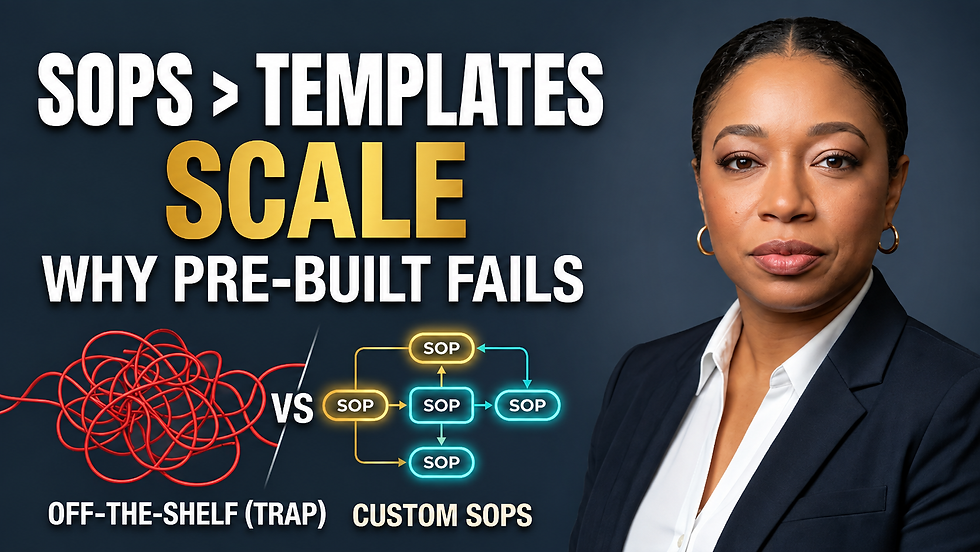
Enterprise firms don't create proposals from scratch.
They don't rewrite onboarding emails every week.
They don't rely on memory.
They rely on systems.
Templates.
Checklists.
Playbooks.
Standard operating procedures.
These tools protect quality while reducing unnecessary work.
AI can make these systems even stronger.
Not because it replaces expertise, but because it accelerates repeatable work.
Imagine having:
Proposal templates
Discovery call agendas
Follow-up email sequences
Client onboarding checklists
Meeting summaries
AI-assisted document reviews
Now imagine a new team member joining your company.
Could they execute confidently using your documentation?
If the answer is no, your business still depends too heavily on knowledge that lives inside people's heads.
Great systems make excellence repeatable.
5. The CEO Shouldn't Be the Client Acquisition System
One statement surprises founders every time I say it.
The CEO of Deloitte isn't sitting on discovery calls.
Why?
Because the organization wasn't designed around one person's availability.
Many growing firms accidentally build businesses where every important decision depends on the founder.
Every proposal.
Every approval.
Every sales call.
Every follow-up.
That approach eventually limits growth.
Instead, enterprise firms distribute responsibility across clearly defined roles supported by documented systems.
The founder becomes the architect.
Not the bottleneck.
Your team doesn't need to become you.
They need systems that help them make consistent decisions.
What a Scalable Client Acquisition System Actually Looks Like
Introduction
Your ideal client discovers your expertise through content, referrals, speaking engagements, podcasts, or strategic partnerships.
Qualification
Clear criteria determine whether the prospect is the right fit before valuable time is invested.
Discovery
A structured conversation uncovers goals, operational challenges, and decision priorities.
Proposal
A standardized proposal presents the solution using proven templates rather than reinventing every document.
Decision
Questions are answered through documented resources, case studies, and consistent communication.
Onboarding
The implementation team takes ownership using established workflows and checklists.
Assessment
Client success is measured, improvements are identified, and future opportunities naturally emerge.
Every stage has a purpose.
Every stage has an owner.
Every stage supports the next.
That is what enterprise consulting firms build.
The Question That Changes Everything
"Does this step actually require me?"
This is one of the most powerful questions a founder can ask.
Review every part of your client acquisition process.
Every meeting.
Every approval.
Every proposal.
Every follow-up.
Ask yourself:
Does this truly require my involvement?
Or does it require a better system?
If removing yourself causes the process to stop, you don't have a client acquisition system.
You have founder dependency.
And founder dependency is one of the biggest barriers to sustainable growth.
Final Thoughts
The biggest lesson I learned from enterprise consulting wasn't about selling.
It was about designing businesses that continue performing without relying on one extraordinary person.
That's how organizations scale.
Not through heroic effort.
Through operational design.
If your business slows down every time you step away, the answer isn't working longer hours.
It's building systems that continue creating opportunities whether you're available or not.
Because the goal isn't simply to win more clients.
It's to build a business that can continue growing without depending on you every step of the way.
Frequently Asked Questions
What is a client acquisition system?
A client acquisition system is a repeatable process that guides potential clients from first awareness to becoming long-term customers. It includes marketing, qualification, sales, onboarding, and follow-up processes.
Why do consulting firms struggle to scale?
Many consulting firms become dependent on the founder to generate leads, conduct discovery calls, approve proposals, and close deals. This creates founder dependency, limiting growth.
What is founder dependency?
Founder dependency occurs when critical business functions rely on one person. The business slows or stops whenever that individual is unavailable.
How do enterprise consulting firms win large contracts?
Enterprise firms build long-term relationships, maintain strategic visibility, document repeatable processes, and empower trained teams to manage client acquisition through structured systems.
How can a small consulting firm build a scalable client acquisition process?
Start by documenting your client journey, creating templates, standardizing communication, using automation where appropriate, and gradually delegating responsibilities supported by clear processes.
Is AI required to build better systems?
No. Strong systems come first. AI simply helps execute documented processes faster and more consistently.
Ready to Build a Business That Doesn't Depend on You?
If you're spending too much time inside your client acquisition process instead of leading your business, it may be time to redesign how your firm operates.
The Operational Freedom Diagnostic is a strategic working session designed to identify operational bottlenecks, uncover founder dependency, and create a practical roadmap for building systems that support sustainable growth.
When your systems improve, your capacity grows.
And when your capacity grows, your business gains the freedom to scale.

Comments