

Why Is Scaling a Service Business So Hard After Early Growth

Here's the truth: your business grew fast because of you. Your hustle, your judgment, your relationships. That early momentum felt like proof you were doing it right.
And you were until now.
Because somewhere between 300K and 500K, the growth that once felt exciting starts to feel like a weight on your chest. Revenue is still coming in. Demand still exists. Marketing still works. But something is off. The calendar is full, decisions pile up, and instead of feeling like you're winning, you feel like you're drowning.
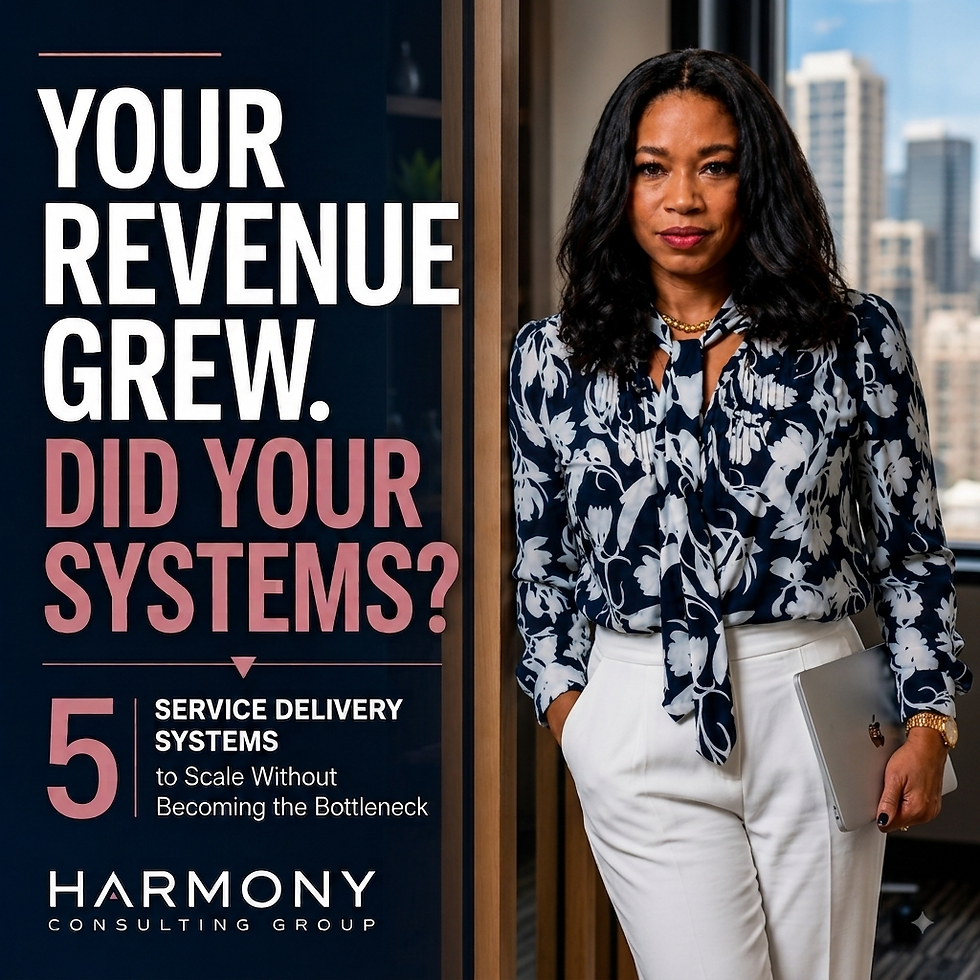
That's not a marketing problem. That's a structural problem. La Tonya Roberts CEO, Fractional Chief Operations Officer, AI Integrator, and Executive Coach at Harmony Consulting Group, who helps service founders build the infrastructure that supports real growth. Through her business, Harmony Consulting Group, and her podcast, Systems That Set You Free, she diagnoses exactly why businesses stall in this range. Her work focuses on removing founder dependency, clarifying decision rights, and creating consistent delivery systems. She also developed the Freedom Systems Blueprint, a model that shows founders how to replace hustle with operational design.
This article covers why service businesses stall at this stage, what structural gaps are creating the ceiling, and how better systems, clearer roles, and stronger metrics get you past it.
Why Scaling a Service Business Gets Stuck Between 300K and 500K
The ceiling isn't about effort. You are not the problem.
The structure is.
At this stage, the business still runs on your judgment. You set strategy, oversee delivery, guide the team, and approve almost everything. At lower revenue, that works. As the business grows, it breaks. The team waits for your answers. Clients expect your brain on every call. Small tasks circle back for your review. You are the bottleneck, and you built the system that made you one.
It's exhausting. It's also completely normal at this stage. But normal doesn't mean permanent.

Why This Stage Feels So Heavy
You bring in more work, but you don't get more space. Every new client adds to your load, not to your team's. More revenue doesn't create freedom. It creates more decisions sitting on your shoulders.
Your team isn't failing you. They're operating inside a structure nobody built to carry this weight.
The Four Gaps Holding the Business Back
Most service businesses between 300K and 500K face the same four structural gaps:
Founder dependency: Every task and answer routes back to you.
Capacity blindness: No one knows how much work the team can actually hold.
Undefined decision rights: Simple choices stall because nobody owns them.
Unstandardized delivery: Work varies by person, which makes handoffs fragile
Each gap creates pressure. Together, they set the ceiling.
What This Means for Your Next Step
Your business produces exactly what you built it to produce. If the structure only holds this level, growth stops here.
But you can fix this. A stronger foundation lets the team carry more, keeps delivery consistent, and frees your time without sacrificing client quality. You don't have to choose between impact and freedom. You can have both when you build the structure.
What Creates the Ceiling When Scaling a Service Business
A business earns exactly what its structure can hold.
The block sitting between you and 500K isn't weak marketing or slow buyers. It comes down to how you built the business. The structure that got you here was never built to take you further. Revenue without structure creates pressure. And that pressure gets louder as you grow.

How Informal Systems Hold You Back
You take on more work, but the way you run the business stays loose. Roles don't have sharp lines. Metrics shift week to week. Nobody tracks capacity, so no one knows when the team hits its limit. You hire because you feel stressed, not because you defined the role.
You push documentation aside. There's a plan to sort it out later. But later never comes. Handoffs slip. Delivery varies. You step in to fix the same issues again.
This isn't a lack of effort. It's a lack of structure. The Three Core Gaps Behind the Ceiling
Capacity without visibility: You can't see the true workload, so growth decisions feel risky and blind.
Undefined decision rights: Without clear ownership, every question routes back to you.
Delivery without standardization: Work varies by person, which creates fragile and inconsistent output.
Fix these three gaps, and growth shifts from strain to stability.
Why Inconsistent Delivery and Weak Metrics Limit Scaling a Service Business
Inconsistent delivery makes growth harder than it needs to be.
When each client gets a slightly different version of your service, it feels personalized. What it actually is: fragile. Margins shift. Quality drops.
You stay pulled into checking the work because no one uses the same method. Repeatability isn't rigid. It's reliable. It gives the team a clear standard and gives you space to lead.

Where Delivery Starts to Slip
As the workload grows, small process gaps become real problems. One person does it one way. Another does it differently. Clients feel the inconsistency. The team slows down because there's no shared method. And you end up in quality control instead of strategy.
The Metrics You Actually Need
Revenue and profit don't tell you enough. To lead with clarity, you need to track:
Client acquisition cost
Delivery margin per offer
Capacity use across the team
Client lifetime value
Operational cost per client
Without these numbers, decisions are driven by emotion. And emotion-based decisions create strain as the business scales. Why Structure Shapes the Ceiling
If the structure shakes at 400K, it will feel chaotic at 800K.
More revenue doesn't fix unclear roles, shaky delegation, uneven delivery, or gaps in capacity planning. It exposes them. Growth doesn't solve weak systems. It amplifies them.
Founder bottlenecks don't fade with scale. They expand. Hustle built your early growth. It cannot build the next stage. You need a stronger design, one that supports stable delivery, clear numbers, and a team that moves without you in the middle of everything. What Helps When Scaling a Service Business Beyond 500K
Breaking the 500K ceiling isn't about working more hours. It's about changing how the business operates.
Three pillars create the structure you need.
Pillar One: Build for Founder Independence
The business must run without your constant presence.
That means installing:
Clear decision frameworks
Documented workflows
Simple leadership layers
These tools help your team move with confidence and cut the daily bottlenecks. You still lead. You just lead from a higher level.

Pillar Two: Create a Capacity Model
A solid capacity model shows how much work the business can handle without breaking. It covers the maximum client load, team usage, delivery bandwidth, and hiring trigger points.
It also stops reactive hiring. Hiring from stress keeps you tired. Planned hiring keeps the business stable.
Pillar Three: Install Operational Visibility
You cannot grow on guesswork. You need:
Dashboards that show real data
Defined KPIs
Weekly review rhythms
These habits shift you from emotional decisions to clear ones. They also surface problems before they escalate, which protects both the team and the client experience.
When the Problem Isn't Slow Growth but Overload Some businesses don't stall. They overload. The structure can't hold the work, so everything strains. You try to fix it, but it takes effort. But effort doesn't replace design.
You need stronger systems. Not more hours.
The Shift That Unlocks the Next Stage
The ceiling between 300K and 500K isn't a failure signal. It's a design signal.
The business needs a new shape. Structure reduces pressure. Design creates space. And with the right setup, you stop choosing between impact and freedom and start building both. Conclusion
Growth slows when the business relies too much on you. You stay busy, but the structure stays fragile. Work stacks up, decisions return to your desk, and the team waits for direction. That pattern drains time and energy, and it doesn't fix itself.
The ceiling isn't permanent.
Clear roles, steady processes, and the right numbers change how the business runs. The team moves faster. Delivery stays consistent. Clients get the same strong result every time, without your time as the variable.
That's the shift that creates real breathing room. You stop firefighting and start leading. Decisions move from guesswork to data. Scaling a Service Business becomes far more manageable once the structure can carry the growth.
The goal isn't more hustle. It's a better design.
When the business runs on clear systems and shared ownership, growth feels steadier, lighter, and far easier to sustain. For more frameworks on scaling your leadership without the burnout, subscribe to my YouTube channel.👉🏼 https://www.youtube.com/@thelatonyaroberts.
FAQs
Why does pricing matter when scaling a Service Business?
Pricing shapes profit, capacity, and team stress. Low prices attract work but compress margins fast. When you price too low, you're forced to take on more clients just to stay afloat. Clear pricing keeps delivery healthy and growth stable.
How does client quality affect scaling a Service Business?
Not every client supports growth. Difficult clients slow delivery, drain the team, and create operational chaos. Clients who respect systems and trust the process make scaling far smoother. Better clients produce better outcomes for everyone.
Why does team training matter when scaling a Service Business?
A team without clear training guesses, makes mistakes, and interrupts constantly. Strong training builds confidence and speed. It also reduces the daily questions that pull you away from strategy.
How does service positioning affect scaling a Service Business?
Vague positioning creates long sales cycles and a team that struggles to communicate value. Clear positioning attracts the right buyers and filters out the wrong ones. It keeps growth focused and intentional.
Why does the founder's mindset affect scaling a Service Business?
Growth demands a different way of thinking. The shift from doing the work to leading the people is real, and it's uncomfortable at first. But that shift is exactly what creates room for the next level.


Comments